by Andreas Hölzl [last update 12.04.2026]
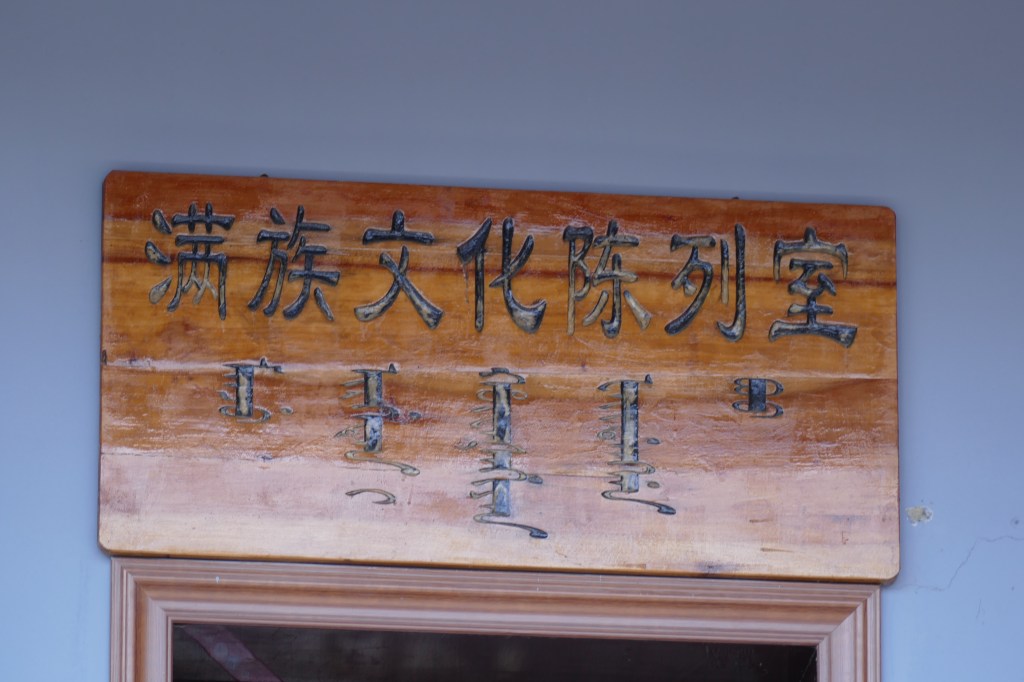
This is an alphabetical list of (written) Manchu words and names that are not found in the standard references like Hauer (2007), Norman (2000, 2013), or Stary (2017). This list will be updated continually:
Alphabetical Word List
- alcuka, alcuha | word class: place name | meaning: refers to a place close to Harbin in Heilongjiang, China | analysis: variable consonant | comment: – | source: alcuka ba i ba na i ejetun | references: Hölzl (2020)
- baili be ujelere diyan | word class: proper name | meaning: name of a building in the mausoleum of Nurhaci in Shenyang (lóng ēn diàn 隆恩殿) | analysis: baili ‘mercy’ + accusative be + ujele- ‘to value greatly’ + imperfective participle -rA + diyan ‘great hall’ | comment: referred to as baili be ujelere deyen in Hauer (2007) and Norman (2013) | source: fieldwork in Liaoning, China, 2009 | reference: see Hölzl (2018b) for a picture
- hūwaša-hiya-n | word class: noun | meaning: culture | analysis: hūwaša- ‘to develop’ + causative -hiyA + nominalizer -n, cf. written Sibe hūwaša-bu-n ‘education’) | comment: inscription probably made by people from Northeast China | source: fieldwork in Guizhou, China, 2019 (see title picture) | references: Hölzl (2023: 175)
- irgeten | word class: noun | meaning: people | analysis: probably a contraction of irgen ‘people’ with another word | comment: inscription probably made by people from Northeast China | source: fieldwork in Guizhou, China, 2019 (see title picture) | references: Hölzl (2023: 175)
- kašigar, kasigar, hasigar | word class: place name | meaning: the city of Kashgar | analysis: variable initial | comment: adapted from Uyghur | source: Huangqing Zhigongtu (hasigar in the Taipei version, kasigar in the Paris version), Qing memorials (kašigar, kasigar) | reference: Di Cosmo (1993: passim) on Qing memorials
- kiyakara | word class: proper name | meaning: the Kyakala (Udihe) people | analysis: – | comment: etymology disputed | source: Huangqing Zhigongtu | references: Hölzl (2018a: 118)
- kiyakara-ta-mbi | word class: verb | meaning: to speak Kyakala | analysis: proper name kiyakara ‘Kyakala’ + verbalizer -tA + citation form -mbi | comment: – | source: Huangqing Zhigongtu | references: Hölzl (2018a: 118)
- parsi gisun | word class: nominal compound | meaning: Persian language | analysis: parsi ‘Persian’ + gisun ‘language’, in Chinese pàěrxī huà 帕爾西話 | comment: probably transmitted via Uyghur given the initial p | source: Huangqing Zhigongtu | reference: –
- wejike | word class: noun, proper name | meaning: forest dweller, the Udihe people | analysis: probably cognate with the name Udihe, weji (< *udi) ‘forest’ + derivational suffix | comment: – | source: recorded in Chinese as wojike 窝集克 | references: Hölzl (2018a: 122, 130)
- to be continued
References
- Di Cosmo, Nicola. 1993. Reports from the Northwest: Selection of Manchu memorials from Kashgar (1806-1807). Bloomington: Indiana University.
- Hauer, Erich. 2007. Handwörterbuch der Mandschusprache. 2nd edn. Wiesbaden: Harrassowitz.
- Hölzl, Andreas. 2020. Language obsolescence in retrospect: The case of Alchuka. First Conference on the Endangered Languages of East Asia (CELEA), 02–03.09.2020, Venice.
- Hölzl, Andreas. 2023. Diachronic changes in constructional networks: Evidence from Manchuric nominal morphology. Constructions and Frames 15(2). 160–186.
- Hölzl, Andreas. 2018a. Udi, Udihe, and the language(s) of the Kyakala. International Journal of Diachronic Linguistics and Linguistic Reconstruction 15. 111–146.
- Hölzl, Andreas. 2018b. Das Mandschurische. Ein diachroner Überblick. Asien-Orient-Institut, Universität Zürich, 16.03.2018, Zürich.
- Norman, Jerry. 2000. A Sibe-English vocabulary. Saksaha. A Review of Manchu Studies 5. 17–40.
- Norman, Jerry. 2013. A comprehensive Manchu-English dictionary. Cambridge: Harvard University Asia Center.
- Stary, Giovanni. 1990. Taschenwörterbuch Sibemandschurisch-Deutsch. Wiesbaden: Harrassowitz.

