by Andreas Hölzl, 20.02.2026

Overview
The Ta-Li languages, also known as Cai-Long 蔡龙 languages in Chinese, are presumably an archaic branch of Sinitic. The Ta-Li languages are located in Guizhou province, China, and include:
- the endangered Caijia 蔡家 language (Glottocode caij1234),
- the extinct but documented Longjia 龙家 language (Glottocode long1417),
- the extinct and only fragmentarily recorded Lujia 芦家 language (also known as Lu or Luren) (Glottocode lure1234),
- and perhaps the extinct and undocument language of the Songjia 宋家.
The name Ta-Li (Glottocode tali1265) was chosen by myself based on two words that (at least in this form) are specific to these languages and possibly exhibit archaic features inherited from Old Chinese like the lateral:
- Caijia ta⁵⁵ ‘two’, li²¹ ‘pig’
- Longjia ta³¹ ‘two’, lɛ⁵⁵ ‘pig’
- Lujia ta³¹ ‘two’, li³¹ ‘pig’
Note that the term Ta-Li thus includes all three attested languages while the term Cai-Long only refers to Caijia and Longjia.
That the three languages are genetically related has been suspected since the 1950s based on superficial and especially lexical similarities. Recently, Hölzl & Hölzl (2025) and Hölzl (submitted) presented clear lexical, grammatical, and structural evidence for such a relationship. Note that the phonological details (some of which are also discussed in recent papers by Lee Man Hei) still need to be worked out in more detail.
Genealogically unrelated but nevertheless connected to the Ta-Li langages are the following two languages (see Hölzl submitted for more details):
- a Trans-Himalayan language called “Nanjing” (no Glottocode), seemingly closely related to Dafang Yi (Glottocode dafa1241) and in contact with Longjia,
- and a possibly isolated language also known as Lu or Luren language (no Glottocode).
In order to differentiate between the two languages called “Luren”, I refer to the one as Luren A (or Lujia) and to the other as Luren B. Since the former Luren are classified as Manchu minority today, both Luren languages were at some point misclassified as Manchu language (see Hölzl & Hölzl 2025 for details). The Longjia language is often misclassified as a Baic variety because the former Longjia today officially belong to the Bai minority.
Status
Caijia, albeit endangered, is the only Ta-Li language still spoken today. Longjia has become extinct during the latter half of the 20th century and Lujia during the first (Hölzl submitted). Songjia, if related to the Ta-Li languages, must have already disappeared earlier and remained entirely undescribed.
Available Data
Caijia
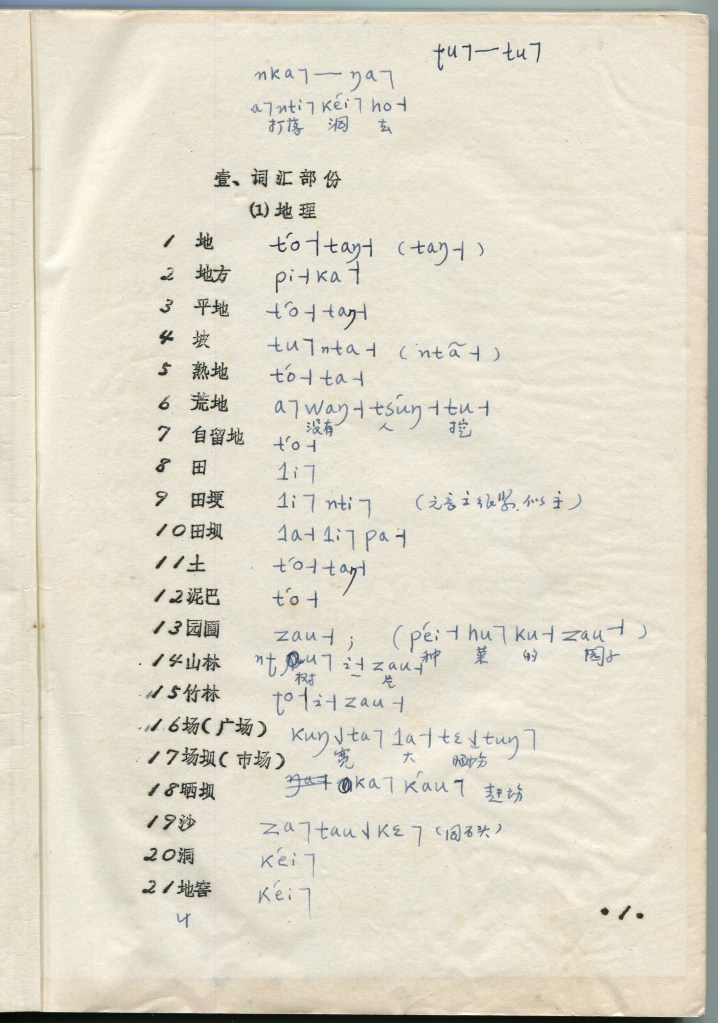
Caijia is the only language with a relatively complete description, including a grammar and publications on various aspects of the grammatical structure in Chinese and English. Despite frequently being referred to as a recently discovered language, the language was actually first described in the 1950s. These data have never been published but some are in my personal possession and are currently being prepared for publication. The first publicly available descriptions, although difficult to access, are from the 1980s. A short sketch of the language in Chinese has been published in 2004 by Bo Wenze. For many years, this remained the only accessible publication of the language. The main reference work today is the excellent grammar written in English by Lü Shanshan that was published in 2022.
Here is a more or less exhaustive list of publications on Caijia (as of 2025):
- Bo Wenze 薄文泽. 2004. Caijiayu gaikuang 蔡家话概况 [A sketch of Caijia]. Minzu Yuwen 民族语文 2. 68–81.
- Chē Guāngxián 车光贤 et al. (eds.).2003. Liùpánshŭishì zhì: mínzú zhì 《六盘水市志:民族志》 [Gazetteer of Liupanshui: Ethnic section]. Guìyáng 贵阳: Guìzhŏu rénmín chūbǎnshè 贵州人民出版社. (p. 184)
- GMSWSB 1982 = Caijia de yuyan 蔡家的语言 [The language of the Caijia]. In Guizhousheng minzu shiwu weiyuanhui shibie bangongshi 贵州省民族事务委员会识别办公室. Guizhou minzu shibie ziliaoji, vol. 8, longjia, caijia 贵州民族识别资料集, 110–125. Guiyang. (Unpublished manuscript.)
- Hsiu, Andrew. 2018. The Niujiaojing dialect of Caijia in Weining County, Guizhou, China. (Unpublished manuscript.)
- Hu Hongyan 胡鸿雁. 2013. Caijiahua daici xitong tanxi 蔡家话代词系统探析. Minzu yuwen 民族语文 6. 34–40.
- Lee, Man Hei. 2023. Phonological features of Caijia that are notable from a diachronic perspective. Journal of Historical Linguistics 13(1). 82–114.
- Lee Man Hei. 2024. Bai and Old Western Chinese. Bulletin of the School of Oriental and African Studies 87(3). 533–555. doi:10.1017/S0041977X24000259
- Lü Shanshan 吕珊珊. 2017. Caijiahua qizhong youbiju de leixingxue kaocha 蔡家话七种优比句的类型学考察. Fangyan 方言 3. 341–351.
- Lü Shanshan. 2018. Two locative constructions in Caijia from the typological perspective of Asian languages. Studies in Language 42(3). 600–640.
- Lü Shanshan 吕珊珊. 2019a. Caijiahua dengbiju de leixingxue kaocha 蔡家话等比句的类型学考察. Yuyan kexue 语言科学 99. 160–175.
- Lü Shanshan. 2019b. Equative and similative constructions in Caijia (Sino-Tibetan). Faits de Langues 50(1). 203–225.
- Lü, Shanshan. 2022. A reference grammar of Caijia: An unclassified language of Guizhou, China (Sinitic Languages of China 8.) Berlin: Mouton.
- Majewicz, Alfred F. 2023. Review of Lü (2022). Rocznik Orientalistyczny 76. 176–184.
- Zhang Yongbin 张永斌. 2018a. Binwei yuyan caijiahua liangci xitong tanxi 濒危语言蔡家话量词系统探析. Anshun xueyuan xuebao 安顺学院学报 20(2). 40–47.
- Zhang Yongbin 张永斌. 2018b. Caijiahua fuju jiqi neibu guanxi kaocha 蔡家话复句及其内部关系考察. Honghe xueyuan xuebao 红河学院学报 16(6). 89–95.
- Zhang Yongbin 张永斌. 2018c. Xin faxian binwei caijiahua xingrongci xitong tanxi 新发现濒危蔡家话形容词系统探析. Guizhou gongcheng yingyong jishu xueyuan xuebao 贵州工程应用技术学院学报 195. 102–110.
- Zhang Yongbin 张永斌. 2018d. Caijiahua cihui jiqi laiyuan xitong tanxi 蔡家话词汇及其来源系统探析. Liupanshui shifan xueyuan xuebao 六盘水师范学院学报 30(5). 1–7.
- Zhengzhang Shangfang 郑张尚芳. 2010. Caijiahua baiyu guanxi ji cigen bijiao 蔡家话白语关系及词根比较 [Relation of the Caijia and Bai language and comparison of lexical roots]. In Pan Wuyun 潘悟云 & Shen Zhongwei 沈钟伟 (eds.), Yanjiu zhi le 研究之乐 [The joy of research], 389–400. Shanghai: Shanghai jiaoyu chubanshe.
Caijia numerals can be found in the Numeral Systems of the World’s Languages database. An online word list was put together by Lee Man Hei. The endangered languages Archive (ELAR) contains audio recordings and videos of Caijia. Unpublished Caijia data collected by Andrew Hsiu can be accessed online as well.
Longjia
Longjia was first described in the 1920s but remains almost unknown until today. While only very few data of the Longjia language have been published, most of which are written in Chinese and almost entirely inaccessible, the language has been recorded in several fieldnotes from the 1950s and the 1980s that are in my personal possession. An overview of all available data can be found in Hölzl (2021, submitted). Together with Yadi Hölzl, I am currently working on a Grammar of Longjia based on these fieldnotes.
Lujia
Lujia is the least well attested of the Ta-Li languages. It was described from the 1950s until the 1980s, at a time when already no fluent speakers of the language were left. As a consequence, the language has only been fragmentarily recorded in a couple of word lists that were recently published and analyzed in Hölzl & Hölzl (2025).
Publications
Books
Hölzl, Andreas. submitted. Studies in East Asian Comparative Linguistics. Potsdam: University of Potsdam. (Cumulative habilitation thesis.)
Papers
- Hölzl, Andreas & Yadi Hölzl. 2025. The lost voices of Guizhou: Rediscovering the languages of the Luren. Cahiers de Linguistique Asie Orientale. DOI
- Hölzl, Andreas. 2021. Longjia (China): Language Contexts. Language Documentation and Description 20. 13–34. URL
Reviews
- Hölzl, Andreas. 2023. Review of Lü (2022). Bulletin of the School of Oriental and African Studies 86(2). 398–399. DOI
Talks
- Hölzl, Andreas. 2023. Describing a recently extinct language: The case of Longjia (Sino-Tibetan). Vielfaltslinguistik 5, 19–20.05.2023, Hamburg.
- Hölzl, Andreas. 2022. Longjia: An archaic Sinitic language. Centre de recherches linguistiques sur l’Asie orientale, CRLAO, 25.10.2022, Paris.
- Hölzl, Andreas. 2022. A typological profile of Longjia, an archaic Sinitic language. 14th Conference of the Association for Linguistic Typology (ALT), 15–17.12.2022, Texas at Austin.
- Hölzl, Andreas. 2022. Unusual word order features in Longjia and Caijia. Syntax Semantik Kolloquium, 26.07.2022, Potsdam.
- Hölzl, Andreas. 2021. Prenasalization in Longjia. The 34th Paris Meeting on East Asian Linguistics (JLAO), 07–09.07.2021, Paris.
- Hölzl, Andreas. 2021. The Lu(ren) languages of Guizhou, China. 9th International Constrastive Linguistics Conference (ICLC), 20–21.05.2021, Santa Margherita-Portofino.
- Hölzl, Andreas & Yadi Hölzl. 2019. The endangered languages of the Manchus. Endangered languages in Northern Asia (Internationaler Workshop), Institut für Turkologie, Freie Universität Berlin, 29–30.11.2019, Berlin.
 Homepage of Andreas Hölzl